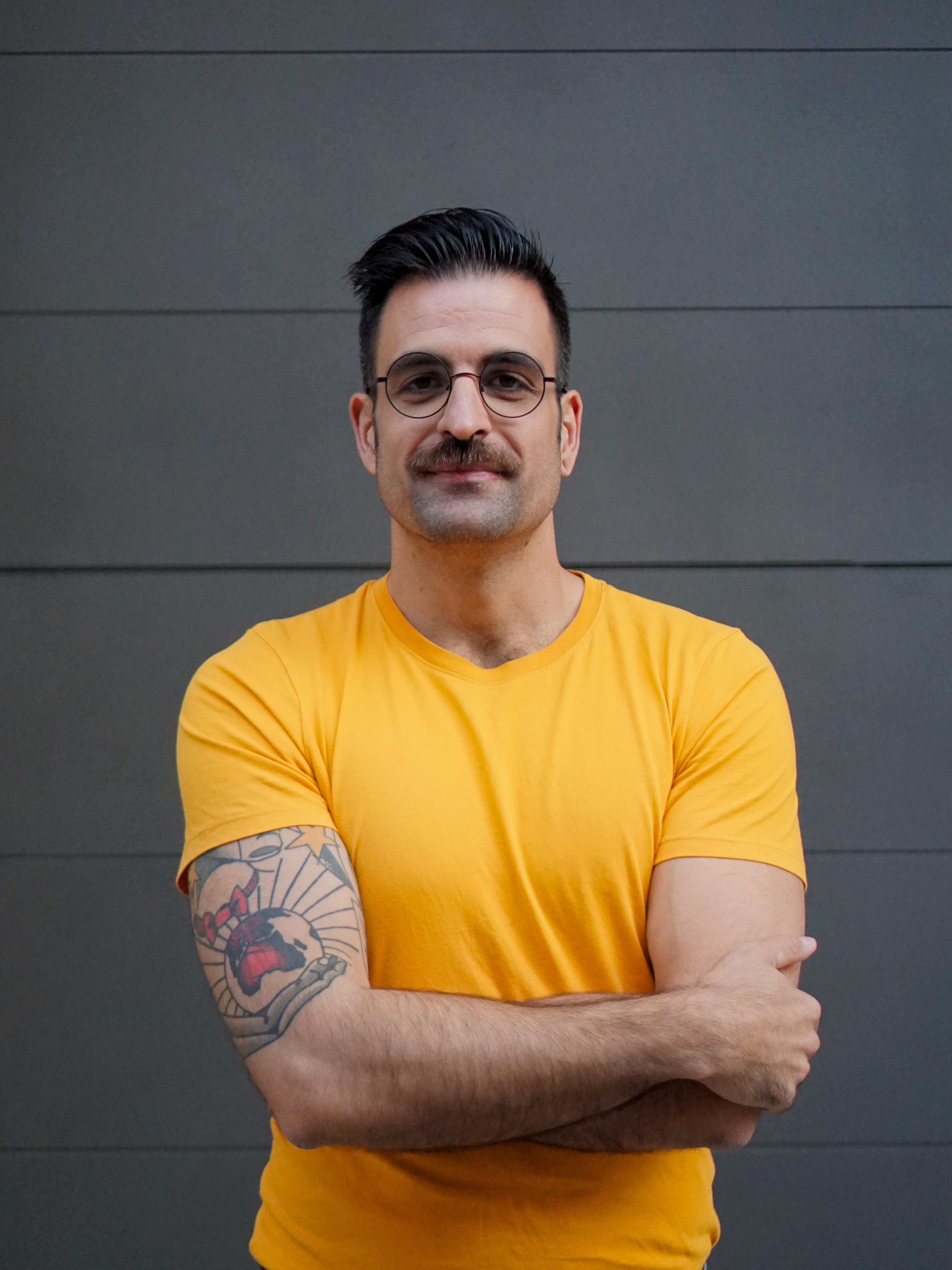
Associate Professor · Universitat de Barcelona
Researching how media shape what we can imagine, fear, and desire about sexuality, prevention, and the past.
An Associate Professor at the intersection of media studies, public health, and critical health communication.
Sergio Villanueva Baselga is Associate Professor at the Universitat de Barcelona. His research examines how media shape cultural understandings of sexuality, sexual health and identity in digital societies, with particular attention to youth media practices, mediatized intimacies, and the narratives that shape stigma and prevention cultures around HIV and emerging prophylactic technologies.
He came to media studies through a laboratory, trained first in biotechnology and biomedical research before turning to communication. He works at the intersection of media studies, public health and critical health communication, combining ethnographic, participatory and quantitative methods.
He has published in New Media & Society, Culture, Health and Sexuality, Public Health, Visual Communication, Infection and MedieKultur: Journal of Media and Communication Research, and is currently co-PI of KALEIDOSCOPE (AEI, 2024–2028) and PI of Past Continuous (Erasmus+ KA220, 2023–2026). His forthcoming Routledge monograph, Sexual Health, Communal Sex, Utopian Ethics: Imagining a Post-Condom World (2026), proposes a queer ethics of pleasure and shared care for a world beyond fear-centric prevention.
He has held visiting positions at the University of Chicago, Aristotle University of Thessaloniki and the University of Exeter, and is a 2026 José Castillejo Fellow at Freie Universität Berlin. Beyond the academy, he coordinates research at ONG Stop, a leading Barcelona-based LGTBIQ+ sexual health organisation, and serves on the Sexual Health Committee of the Barcelona Municipality, where his academic research feeds directly into city-level prevention policy.
Each combines critical media analysis with public-health and ethnographic methods.
Critical analysis of how news, fiction and digital platforms communicate sexual health and prophylactic technologies, from PrEP to Doxy-PEP.
Sexualized and mediatized intimacies among youth (social media, podcasts, pornography, smut) and how these reshape sexual literacy beyond formal sex education.
Queer sexual cultures, group sex and sex in the plural, and the cultural politics of pleasure, affection, vulnerability and community.
The persistence of HIV stigma in mainstream media (the Philadelphia Syndrome) and the cultural lag between fiction and the era of undetectability.
Media, cultural trauma and historical memory: Spanish Civil War cinemas, Francoist exhumations, Catalan memorial sites, and women's voices recovered through epistolary film.
Emergent counter-publics and online sexual politics, from antifeminist youth cultures to queer organising in non-Western contexts like Equatorial Guinea.
A forthcoming Routledge monograph synthesising a decade of work on sexual cultures, biomedical prophylaxis and queer ethics.
The book offers a theoretical framework for a world in which the condom is no longer the norm. Drawing on queer theory, media analysis, porn studies, sexological history, medical humanities and epidemiological data, it travels through ancient orgies, polyamorous networks, swinger clubs, BDSM dungeons, women-only saunas and chemsex sessions to interrogate how biomedical prevention (PrEP, Doxy-PEP, MenB and HPV vaccines) reshapes sexual scripts. It articulates epiqueerean ethics: a queered hedonism for caring, communal, condomless-yet-protected pleasures, and an invitation to imagine sexual futures that earlier fear-driven scripts foreclose.
Selected, from 2020. Quartile rankings as indexed in Scopus / SSCI / SCI / AHCI.
A selection of grants and active projects led as Principal Investigator or Co-PI.
Observatory for Sexualities, Youth and Media: identifying needs and providing solutions for youth and education, healthcare and media professionals. Funded by AEI Spain (PID2023-146858OB-I00). With M.J. Masanet (UB).
Digital Information Literacy innovating History School Curricula. Erasmus+ KA220 partnership with consortia in Spain, Italy, Greece and Hungary.
Young Spanish-speaking migrants in Berlin and Barcelona facing the expansion of biomedical prophylaxis in sexual health. José Castillejo Programme, Spanish Ministry of Universities (ref. CAS24/00059). Hosted by Freie Universität Berlin.
Bridges between academic research, community organisations, public institutions, and broad audiences.
Postgraduate and undergraduate teaching at the Universitat de Barcelona.
I teach at the Universitat de Barcelona across the BA in Communication and Media Studies and two postgraduate programmes (the MSc in Research in Communication and Diversities and the CHARM-EU Master of Global Challenges for Sustainability). My current courses focus on research methods, media studies, and the intersections of media, identities and health.
I have supervised over thirty BA final projects, several MA theses (one awarded the Outstanding TFM Award), and four doctoral theses (two defended, two in progress).
In 2022 my faculty teaching-innovation group was awarded the Vicenç Vives prize for Quality of Teaching by the Generalitat de Catalunya and the Universitat de Barcelona.
For research collaborations, invited talks, doctoral supervision enquiries, or media requests.